
Indexed Universal Life Insurance Plans: A Complete Guide
Are you looking for a life insurance plan that offers both protection and the potential for cash growth? Many people want more than just a safety net for their loved ones—they want a plan that also helps build savings over time. Indexed Universal Life Insurance (IUL) promises to do just that. This unique type of insurance combines lifelong coverage with a cash value account linked to a stock market index, such as the S&P 500. But how does it really work, and is it right for you? Let’s explore how IUL plans function, their key features, and what you need to know before making a decision.
What Is Indexed Universal Life Insurance?
Indexed Universal Life Insurance is a type of permanent life insurance. Unlike term life insurance, which lasts for a set number of years, IUL covers you for your entire life as long as you pay the premiums. The main difference lies in how the cash value component grows. Instead of a fixed interest rate, the growth is tied to the performance of a market index.
When you pay your premium, part of it covers the cost of insurance. The rest goes into the policy’s cash value account. Each year, the insurer credits interest to this cash value based on how the chosen index performs, up to a certain cap.
If the index does well, your cash value may grow faster. If it does poorly, your cash value is protected from losses, usually earning a minimum interest rate.
How Does Iul Work?
To understand IUL, it helps to break down the process:
- Premiums: You pay flexible premiums, which can be higher or lower after the first year.
- Cost of Insurance: Part of your premium covers the death benefit.
- Cash Value Growth: The remaining premium goes into cash value, which grows based on a market index.
- Interest Crediting: The insurer credits interest to your account, up to a cap (for example, 10% per year) and with a guaranteed minimum (often 0% or 1%).
- Policy Loans and Withdrawals: You can borrow or withdraw from your cash value, though this may reduce your death benefit.
Here’s a simple example: Imagine you pay $5,000 per year for your IUL policy. After covering insurance costs, $3,000 goes into your cash value. If your plan links to the S&P 500 and the index rises 12% in a year, your policy may credit you the cap rate, say 10%. If the index falls -5%, you might still receive a 1% minimum interest.
Comparing Iul To Other Life Insurance Types
Below is a comparison of IUL with Whole Life and Variable Universal Life (VUL) insurance:
| Feature | Indexed Universal Life | Whole Life | Variable Universal Life |
|---|---|---|---|
| Cash Value Growth | Linked to market index, capped | Guaranteed, fixed rate | Invested in sub-accounts (like mutual funds) |
| Premium Flexibility | Flexible | Fixed | Flexible |
| Risk Level | Moderate (no direct losses from market drops) | Low | High (cash value can decrease with market) |
| Minimum Interest Rate | Yes | Yes | No |
:max_bytes(150000):strip_icc()/pros-cons-indexed-universal-life-insuranc_edit-4aac00c34d804ac0b766368cb4c95f1b.png)
Credit: www.investopedia.com
Key Features Of Indexed Universal Life Insurance
Flexible Premiums
Unlike whole life insurance, IUL allows you to adjust your premium payments. You can pay more in good years to build cash value faster, or pay the minimum required to keep the policy active.
Adjustable Death Benefit
You can often increase or decrease your death benefit, subject to approval and possible medical review. This flexibility helps you adapt as your needs change.
Cash Value Growth Tied To Index Performance
The cash value grows based on the performance of a chosen market index, such as the S&P 500. However, you’re not directly investing in the market. The insurer uses a formula to calculate your interest credit, with a cap and a floor.
Downside Protection
One of the main draws of IUL is that you cannot lose cash value due to poor market performance. Even if the index falls, your cash value usually gets a minimum credited interest, often called the “floor rate. ”
Tax Advantages
The cash value grows tax-deferred, which means you don’t pay taxes on the gains as long as the money stays in the policy. Policy loans are also generally tax-free, as long as the policy stays in force.
How Interest Crediting Works In Iul
Interest crediting is a unique part of IUL. The insurer uses a formula based on the performance of a chosen index.
- Cap Rate: The maximum interest you can earn in a year (e.g., 9%).
- Participation Rate: The percentage of the index’s gain credited to your account (e.g., 80%).
- Floor Rate: The minimum interest you can earn, even in a market downturn (e.g., 1%).
For example, if the S&P 500 rises 12%, with a 9% cap and 80% participation, your credited interest would be: 12% x 80% = 9.6%, but capped at 9%. If the index falls -5%, you’d still earn the floor rate of 1%.
Credit: www.figmarketing.com
Pros And Cons Of Indexed Universal Life Insurance
Understanding both advantages and drawbacks is key before buying an IUL policy.
Advantages
- Lifelong coverage: As long as you pay premiums, your coverage never expires.
- Potential for higher returns: Cash value may grow faster than with whole life insurance, depending on index performance.
- No direct market risk: Your cash value won’t drop if the index falls.
- Flexible premiums and benefits: Adjust as your life changes.
- Tax-deferred cash value growth: Pay no taxes on gains until withdrawn.
Drawbacks
- Caps and participation rates: Limit your upside, so you may not get the full index return.
- Complexity: IUL policies have many moving parts and fees that are hard to understand.
- Costs can rise: If cash value growth is slow, you might need to pay higher premiums to keep your policy in force.
- Loan risk: Borrowing too much from your policy can cause it to lapse and trigger taxes.
Not-so-obvious Insights
- IULs are not investment accounts: Some agents may market IULs as a substitute for investing, but the returns are generally lower than direct investments in the stock market.
- Policy design matters: The way your policy is structured—how much you pay, how much insurance you buy, and how you use loans—can dramatically change your results.
Who Should Consider Indexed Universal Life Insurance?
IUL is not for everyone. Here’s who may benefit most:
- People with high incomes who want a tax-advantaged way to build wealth.
- Those needing lifelong coverage with flexibility.
- Individuals who have maxed out other retirement accounts like 401(k)s and IRAs.
- People comfortable with complexity and able to review their policy regularly.
If you want simple, low-cost coverage, IUL may not be the best choice.
Costs And Fees
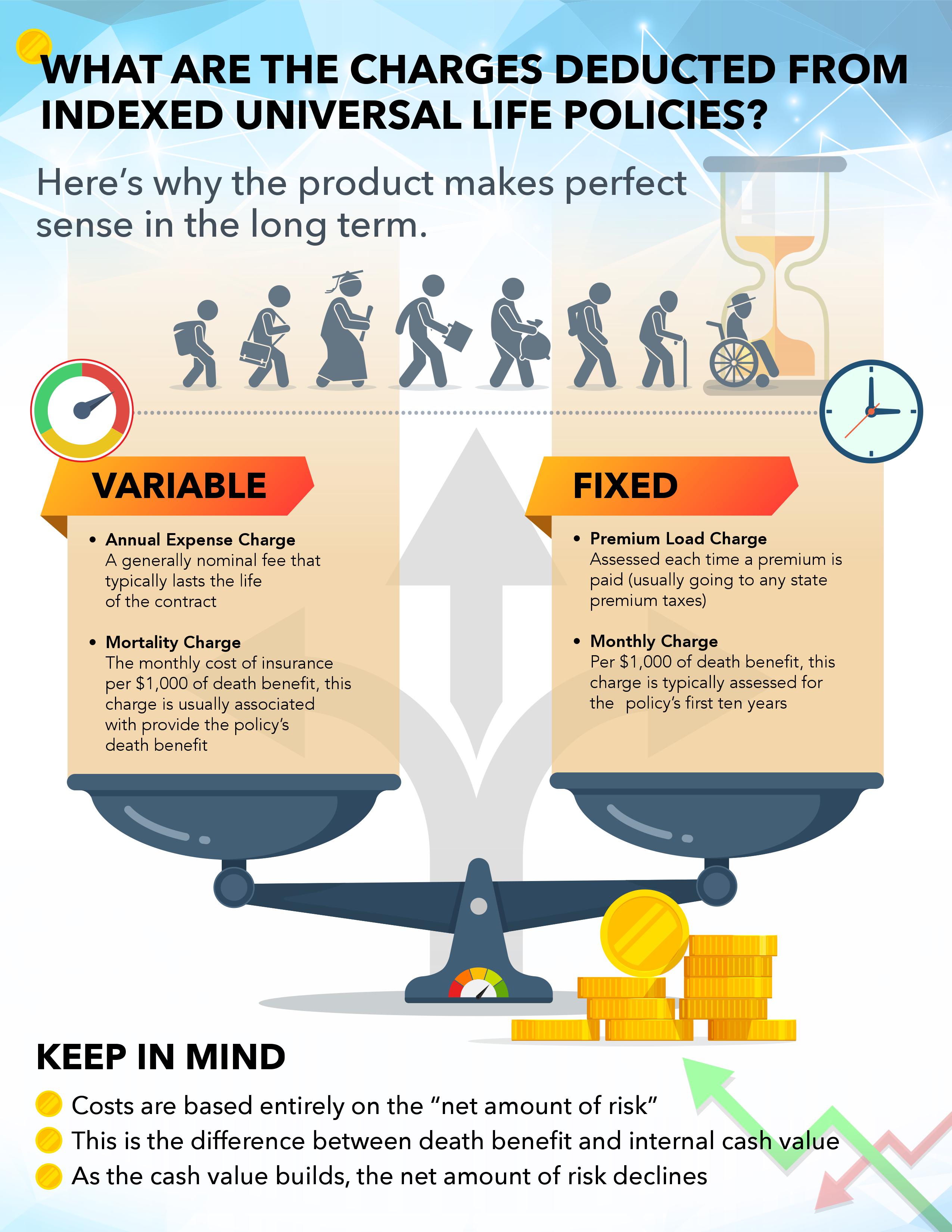
IUL policies come with a variety of charges:
- Cost of insurance: Increases as you age.
- Administrative fees: Monthly or annual charges.
- Surrender charges: Fees for canceling your policy early.
- Rider fees: Extra charges for features like accelerated death benefits.
Understanding these fees is critical. High costs can eat into your cash value growth, especially in the early years.
Real-world Example
Let’s look at how an IUL policy might work for a 40-year-old non-smoker, male, in good health:
- Death benefit: $500,000
- Annual premium: $7,500
- Index: S&P 500, 9% cap, 1% floor
After 20 years, if the market performs well, the cash value could grow to over $100,000. If the market is flat or negative, the cash value might only be $40,000–$60,000, but the death benefit remains in place. This is just an example—actual numbers depend on many factors, including your health, age, and how the policy is managed.
:max_bytes(150000):strip_icc()/Pros-and-cons-indexed-universal-life-insurance_final-1b83c0fd52154eb69edd47f99ab8927a.png)
Credit: www.investopedia.com
Common Mistakes With Iul Policies
It’s easy to make mistakes with indexed universal life insurance. Here are a few to watch out for:
- Ignoring the fine print: Don’t focus only on the upside. Read about caps, fees, and policy charges.
- Underfunding the policy: If you pay the minimum premium, cash value may not grow enough to cover rising costs later.
- Not reviewing regularly: Index choices, caps, and fees can change. Check your policy every year.
- Relying on loans without a plan: Policy loans can be a helpful tool, but if not repaid, they can reduce your death benefit or even cause the policy to lapse.
Popular Indexes Used In Iul Plans
Most IULs use popular market indexes to determine interest credits. Here are a few commonly used ones:
- S&P 500: The most common index, representing 500 large U.S. companies.
- NASDAQ 100: Focuses on tech-heavy stocks.
- Russell 2000: Tracks small-cap U.S. companies.
- Euro Stoxx 50: Represents large European companies.
Some policies offer a choice of multiple indexes or “blended” strategies.
How To Choose The Right Iul Policy
Choosing an IUL plan means looking at more than just the index. Here’s what to consider:
- Caps and participation rates: Higher caps and participation rates can mean better potential growth.
- Fees and charges: Lower fees help your cash value grow faster.
- Company strength: Buy from an insurer with high financial ratings.
- Policy flexibility: Make sure you can adjust premiums and death benefits as your needs change.
- Agent experience: Work with an agent who can clearly explain the policy and answer all your questions.
Here’s a simple side-by-side of two sample policies:
| Feature | Policy A | Policy B |
|---|---|---|
| Cap Rate | 10% | 8.5% |
| Floor Rate | 1% | 0% |
| Annual Fees | $400 | $350 |
| Index Choices | 3 options | 5 options |
| Loan Interest Rate | 5% | 4.5% |
Tax Implications
A big advantage of IUL is the tax-deferred growth. You don’t pay taxes on the interest credited to your cash value. Withdrawals and loans are usually tax-free, as long as the policy doesn’t lapse.
But if you withdraw more than you put in (your “basis”), or if the policy lapses with a loan outstanding, you may owe taxes. Also, IULs are subject to Modified Endowment Contract (MEC) rules. If too much money is paid in too quickly, your policy could lose tax advantages.
Is Indexed Universal Life Insurance Right For You?
IUL can be a powerful tool for the right person, but it’s not a one-size-fits-all solution. If you want lifelong coverage, flexibility, and the potential for higher cash value growth without market losses, IUL deserves a closer look. But if you want a simple, low-cost policy or you’re not willing to review your policy regularly, consider other options.
Before buying, compare several policies, ask about all fees, and make sure you understand the index crediting method. You might also want to read more on insurance industry resources like Investopedia.
Frequently Asked Questions
What Happens If The Market Index Goes Down?
Your cash value is protected by a floor rate (often 0% or 1%). This means you won’t lose cash value due to a market decline, though you may not earn interest that year.
Can I Change My Index Selection Later?
Many IUL policies allow you to choose different indexes or strategies each year. Check with your insurer to see what options your policy offers.
Are Policy Loans Taxable?
Policy loans are generally not taxable as long as the policy remains active. If the policy lapses with a loan outstanding, the loan amount could become taxable income.
How Much Can I Pay Into My Iul Policy?
You can often pay more than the minimum premium, but there are IRS limits. Paying too much can cause your policy to become a Modified Endowment Contract (MEC), which changes its tax treatment.
Is Iul A Good Investment For Retirement?
IUL can be a useful tool for tax-advantaged savings, but it’s not a replacement for traditional retirement accounts like 401(k)s or IRAs. Use it as a supplement if you’ve already maxed out other options.
Indexed Universal Life Insurance can offer both security and the chance for growth, but it’s essential to read the details and work with a knowledgeable advisor. With careful planning, it may become a valuable part of your financial strategy.
Read More:
- Condo Insurance Policy Comparison: Find the Best Coverage Fast
- Directors And Officers Insurance Coverage: Essential Protection Guide
- Professional Liability Insurance Coverage: What You Need to Know
- Best Home Insurance Discounts 2026: Unlock Big Savings Now
- Expat Health Insurance Coverage: What You Need to Know Now
- High Net Worth Insurance Providers: Secure Your Wealth Today
- Insurance SEO Services for Agencies: Boost Rankings & Leads
- Insurance Claim Settlement Process: Step-by-Step Guide to Success